
…New research examines the issue. It’s titled “The Life and Death of Stars That Capture Primordial Black Holes,” and it’s available at arxiv.org…
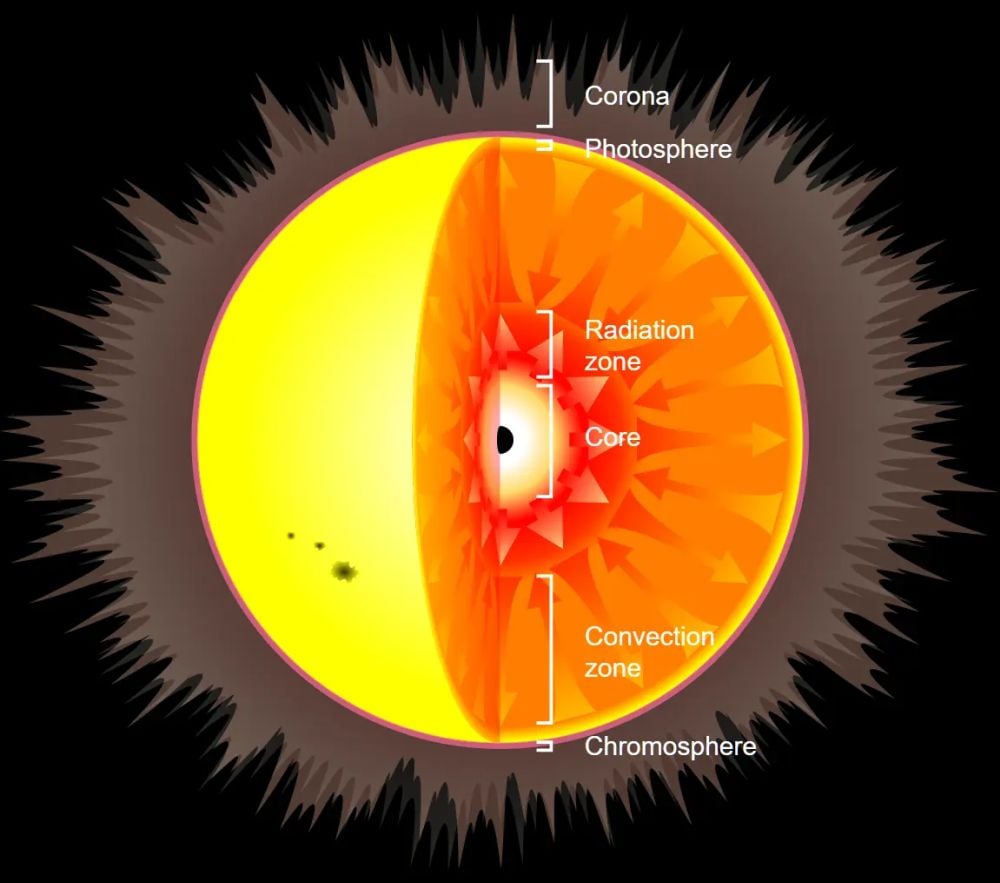
…When a star captures a PBH, the PBH finds its way to the stellar core. Once there, it accretes material from the star’s interior, having a dramatic effect on the star’s evolution. "The resulting object, a “Hawking star”…
There are two diverging paths post engulfment, and both are terminal…
It’s all about disk formation, which is governed largely by angular momentum. Above a certain threshold, accretion is rapid, and powerful feedback destroys the star. If accretion is slow and steady, the Hawking star can survive…
The quiet terminal branch potentially produces gravitational waves (GWs). While the explosive branch leaves behind a low-mass, rapidly spinning BH…“Any future GW detection of a compact binary containing a subsolar or otherwise anomalous low-mass BH would be a striking signature of nonstandard compact-object formation.”
The remnants from both branches are valuable probes of PBH. “Their rates, environments, and electromagnetic signatures could constrain the PBH contribution to dark matter,” write the authors…
Don’t primordial black holes evaporate to Hawking radiation before stars could exist?
Only the smallest ones.
I believe there’s an exponential relationship between size and rate of decay. So tiny black holes evaporate almost instantly, whereas anything as massive as a planet (still small for a black hole) would outlast all stars.
PBH with mass <10^6g would have evaporated before the universe had cooled enough for atoms to form. Its possible they didn’t fully evaporate, but instead became “Plank relics”, which are a dark matter candidate.
PBH with mass 10^7g to 10^16g would have evaporated already, producing a background of gamma rays and gravity waves that we don’t see.
PBH with mass 10^17g to 10^22g would still exist today, and the gravity waves they generate are too small to be detected by current detectors. These are also a dark matter candidate.
PBH with mass >10^23, in sufficient numbers to explain the existence of dark matter, would cause gravity lensing that we don’t observe.
So according to observations, if the early universe produced PBH, they didn’t have an even distribution of masses from giant to tiny. Either they were all tiny (<1 ton), or they were all medium size (asteroid mass).
My favorite explanation of dark matter is the formation of asteroid mass PBHs when the early universe went through the phase change that separated the electroweak force into the electromagnetic force & nuclear weak force. Just a bit before electroweak symmetry breaking, the universe was in a state of supercooled false vacuum, and then bubbles of today’s vacuum energy started expanding. The pockets of false vacuum between the expanding bubbles of true vacuum would be slower to inflate, causing their density to grow relative to the rest of the universe, until they collapse into PBH. Because they’re all formed at the same time, from similar size pockets of similar density plasma, the resulting population of PBH are uniformly asteroid mass rather than having a Gaussian mass distribution.
Further reading:
Gaussian Planck Relics are Ruled-Out as Dark Matter by LIGO
Constraints on primordial black holes from the Galactic gamma-ray background
When a primordial black hole and a star like and love each other very very much… 💋
Yay, brand new interstellar bypass, aww!
Soooo cute!!
