
…New research examines the issue. It’s titled “The Life and Death of Stars That Capture Primordial Black Holes,” and it’s available at arxiv.org…
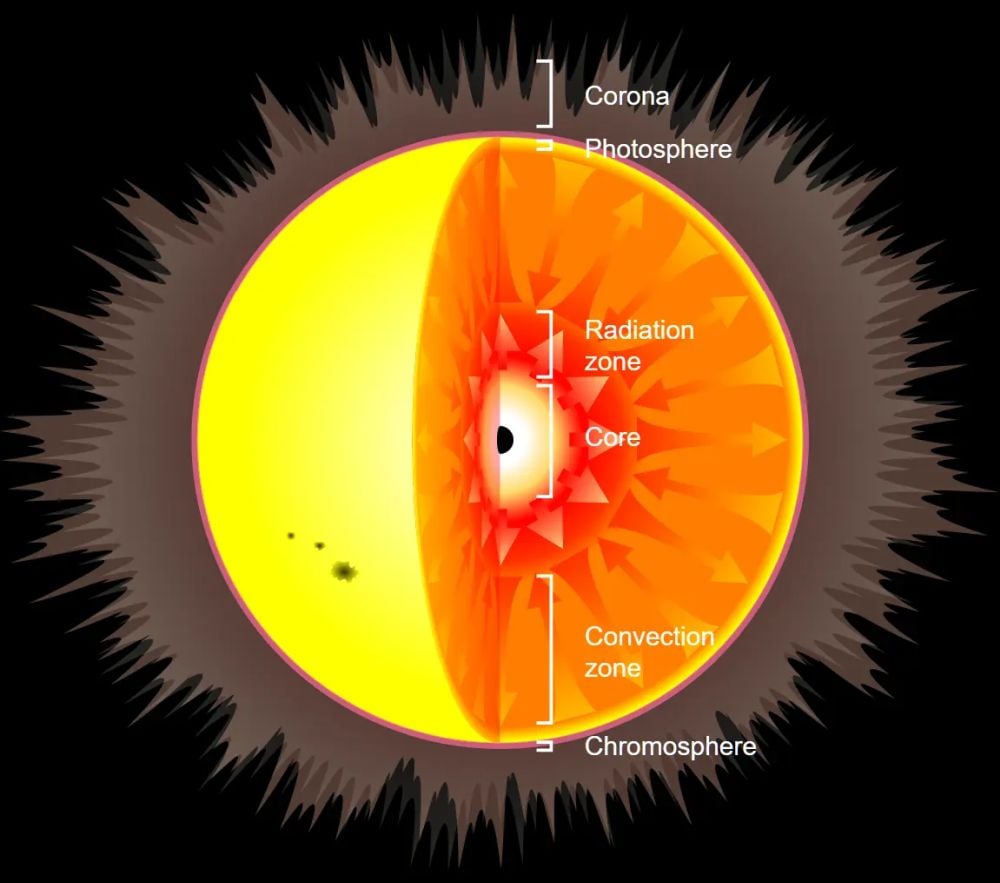
…When a star captures a PBH, the PBH finds its way to the stellar core. Once there, it accretes material from the star’s interior, having a dramatic effect on the star’s evolution. "The resulting object, a “Hawking star”…
There are two diverging paths post engulfment, and both are terminal…
It’s all about disk formation, which is governed largely by angular momentum. Above a certain threshold, accretion is rapid, and powerful feedback destroys the star. If accretion is slow and steady, the Hawking star can survive…
The quiet terminal branch potentially produces gravitational waves (GWs). While the explosive branch leaves behind a low-mass, rapidly spinning BH…“Any future GW detection of a compact binary containing a subsolar or otherwise anomalous low-mass BH would be a striking signature of nonstandard compact-object formation.”
The remnants from both branches are valuable probes of PBH. “Their rates, environments, and electromagnetic signatures could constrain the PBH contribution to dark matter,” write the authors…
When a primordial black hole and a star like and love each other very very much… 💋
Yay, brand new interstellar bypass, aww!
Soooo cute!!