
• 0 Posts
  • 7 Comments
Joined 3 years ago
cake
Cake day: June 11th, 2023

help-circle
  • I’m not a representative sample, but…

    …my hobby is my job. I learnt to code and to build stuff as a hobby, and now it’s my job.

    I don’t think I could exist without designing and building something interesting. Even if I know that someone out there does it better. Because I want to understand the process and be able to alter it. I’m OK with someone else doing something that I find boring. If the subject interests me, I want to do it myself.

    As for the concept of being free, if someone said “you’re free now”, I would ask “in what sense - am I free to stop paying taxes and repaying debt? can I finally squat land, start a license free mobile phone network and start practising medicine, or free in some other sense?”. I would likely conclude that I’m not free yet, and mutual dependencies are in fact quite numerous.


  • Out of curiosity I checked if their sources properly accounted for confounding variables (e.g. age, because the global population is aging). I didn’t check all, but all the sources that did I check accounted for age properly.

    Then I scanned some more. To bring a medical viewpoint into the discussion, took a particularly close look at one of the referenced studies of 67 health risk factors, to determine if it’s stress, pollutants, communicable or environment-triggred disease that is harming people most.

    The factors dishing out most harm seem to be diseases with a lifestyle / stress component (high blood pressure), behaviour patterns with a stress component (overconsumption of food and intoxicants, primarily alcocol and tobacco), and only after these comes home air pollution (cooking with open fire in developing countries). Outdoor air pollution (“ambient particulate matter pollution”) isn’t in the top 5, but one one diagram, it’s factor number six.
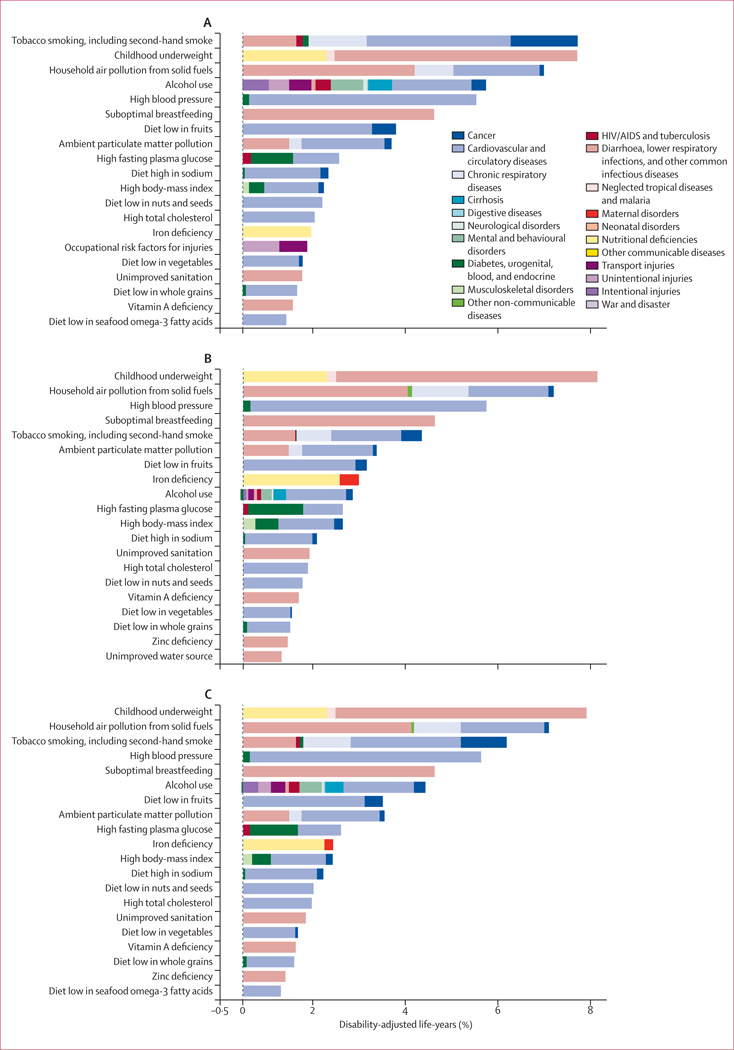
    (Reservation of judgement: there’s not enough data yet about chemicals in the food chain. Pesticides and microplastics definitely need attention, there is absolutely no reason to expect no effect. The effect has to be measured and summarized.)

    Quoting the relevant passage from “A comparative risk assessment of burden of disease and injury attributable to 67 risk factors and risk factor clusters in 21 regions, 1990-2010: a systematic analysis for the Global Burden of Disease Study 2010”

    Findings: In 2010, the three leading risk factors for global disease burden were high blood pressure (7·0% [95% uncertainty interval 6·2-7·7] of global DALYs), tobacco smoking including second-hand smoke (6·3% [5·5-7·0]), and alcohol use (5·5% [5·0-5·9]). In 1990, the leading risks were childhood underweight (7·9% [6·8-9·4]), household air pollution from solid fuels (HAP; 7·0% [5·6-8·3]), and tobacco smoking including second-hand smoke (6·1% [5·4-6·8]). Dietary risk factors and physical inactivity collectively accounted for 10·0% (95% UI 9·2-10·8) of global DALYs in 2010, with the most prominent dietary risks being diets low in fruits and those high in sodium. Several risks that primarily affect childhood communicable diseases, including unimproved water and sanitation and childhood micronutrient deficiencies, fell in rank between 1990 and 2010, with unimproved water and sanitation accounting for 0·9% (0·4-1·6) of global DALYs in 2010. However, in most of sub-Saharan Africa childhood underweight, HAP, and non-exclusive and discontinued breastfeeding were the leading risks in 2010, while HAP was the leading risk in south Asia. The leading risk factor in Eastern Europe, most of Latin America, and southern sub-Saharan Africa in 2010 was alcohol use; in most of Asia, North Africa and Middle East, and central Europe it was high blood pressure. Despite declines, tobacco smoking including second-hand smoke remained the leading risk in high-income north America and western Europe. High body-mass index has increased globally and it is the leading risk in Australasia and southern Latin America, and also ranks high in other high-income regions, North Africa and Middle East, and Oceania.

    My personal conclusion: it’s not pollutants harming us yet. Pollutant densities may well increase (but many are decreasing, e.g. people are cooking less with gas and solid fuel) but our social conditions are stressful as shit, and that encourages certain behaviours which have an evolutionary factor.

    E.g. people are prone to over-eat when they have plentiful food, even if the food is junk and there’s no need to eat more. A sedentary lifestyle and driving instead of walking then doubles down on that. People are prone to relieve stress by consuming tobacco and alcohol, despite it harming them. Our ancestors didn’t have an unlimited access to food, booze and stuff to smoke for a passtime, and didn’t evolve defense mechanisms against such behaviour patterns.

    But as usual, culture getst to be the first responder. Genes will take millenia to get anything done, but culture can get things done in decades. Awareness of how people harm their health, and awareness of how society may be encouraging self-harm, needs to spread.


  • The concerns are legit. :(

    Then again, empires and wars make for great story material. Persistent peace… not so much. So I believe science fiction has a bias towards epic messes.

    As for when this was written - wow, 1978. Probably before Iain M. Banks brought a typewriter home and started typing his first Culture novel…

    …but as a result of his typing, even libertarian / socialist viewpoints of science fiction contain empires (often defeated) and wars (sometimes resolved without mass casualties, but not always). The damnable reality of literature tends to be: if there’s no gun on the wall in chapter 1 and someone isn’t shot by chapter 3, you have to figure out what sells the story. :(


  • The executive order in question is likely no. 14215, currently disputed in court by the DNC. Among other things, it says:

    "(b) “Agency,” unless otherwise indicated, means any authority of the United States that is an “agency” under 44 U.S.C. 3502(1), and shall also include the Federal Election Commission.

    …and also…

    The President and the Attorney General, subject to the President’s supervision and control, shall provide authoritative interpretations of law for the executive branch. The President and the Attorney General’s opinions on questions of law are controlling on all employees in the conduct of their official duties.

    No employee of the executive branch acting in their official capacity may advance an interpretation of the law as the position of the United States that contravenes the President or the Attorney General’s opinion on a matter of law, including but not limited to the issuance of regulations, guidance, and positions advanced in litigation, unless authorized to do so by the President or in writing by the Attorney General.

    It’s easy to foresee that he wants to alter the constitutional order and establish an authoritarian regime.

    Some sound advise to people in the US:

    • observe what becomes of the legal challenges to this and other executive orders
    • see what political action you can take within established frameworks
    • get in touch and establish communications with like-minded people

    If the situation worsens, you will benefit from secure communications between people, to hold your councils, make smarter decisions and organize action.

    Also, some controversial advise:

    • if you’re into tech, find a nice hobby involving something like drones, model planes, airships, tethered blimps, kites, rockets, RC cars, boats, subs or even stationary robots - something that is interesting and fits your budget (let’s hope you’ll use your skills for fun and wholesome things, but life could make corrections)

    • it also benefits to know your way around communications: how to participate in a mesh network, how to establish a radio link to some distance, how to lay single mode bare fiber between 2 points exceptionally fast


  • Pigs are intelligent and curious creatures, so it’s possible that they would learn this.

    However, they might come looking at a ground ambush FPV for other reasons too - most FPV controllers slowly spin their motors when armed, or beep (resonate their motors) to indicate that they’re armed. This could draw attention - pigs might think that a piglet is in trouble and come looking. Hopefully not touching, because on that screenshot, the warhead is also waiting to be touched.

    But the killed-to-wounded ratio (as well as the overall loss ratio) is probably very bad for Russians:

    • if a front moves slowly, leaving devastated land behind it, those who come across that land, they won’t have infrastructure supporting them
    • Ukrainians do not seem hell bent on crawling slowly across devastated land, they either defend or do maneuver warfare… Russians seem to have different priorities, they attack even when the attack is very costly
    • these days, any vehicle is a target for FPV drones and must be equipped with powerful electronic countermeasures (which also announce its presence) to survive
    • but some FPV drones lock onto targets with machine vision and others are piloted over optical cable, and there’s not much hope against these even with jammers
    • so, approximately within 7 km of the front, vehicles are a risky thing to have
    • evacuating a wounded person to a distance of 7 km to get him on a vehicle requires non-trivial effort
    • if the official tactic is making “meat attacks”, it’s hard to imagine where that effort comes from

    So, that effort probably doesn’t happen.

    I know of a company in Ukraine making remote operated ground vehicles (“stretcher on tracks”) that can be used to evacuate a person even if they cannot steer the vehicle, but even Ukrainians have few such tools. Russians probably aren’t bothering.


  • Regarding infiltration of the police - a similar theme played out in Greece during the 2008 economic crisis, when Golden Dawn vied for power - they tried hard to infiltrate the police, and succeeded to a considerable degree.

    At some point, they made a mistake, though - GD thugs killed a popular leftist rapper named Pavlos Fyssas. He was able to point out who stabbed him. His death caused widespread rioting. Rioting incapacitated GD temporarily by blocking and damaging their party offices while the security service raided high-ranking members for evidence (apparently they didn’t manage to infiltrate counterintelligence and in the confusion probably couldn’t dispose of evidence even if they knew of incoming raids) …and evidence was plentiful. They were banned and leaders got meaningful sentences in courts.

    Only in a country where entering the police force requires lengthy studies to obtain a diploma (and background checks), is there some chance of random bozos not worming their way in. Most states of the US aren’t such a place, sadly.