

- cross-posted to:
- lobsters@lemmy.bestiver.se
- cross-posted to:
- lobsters@lemmy.bestiver.se
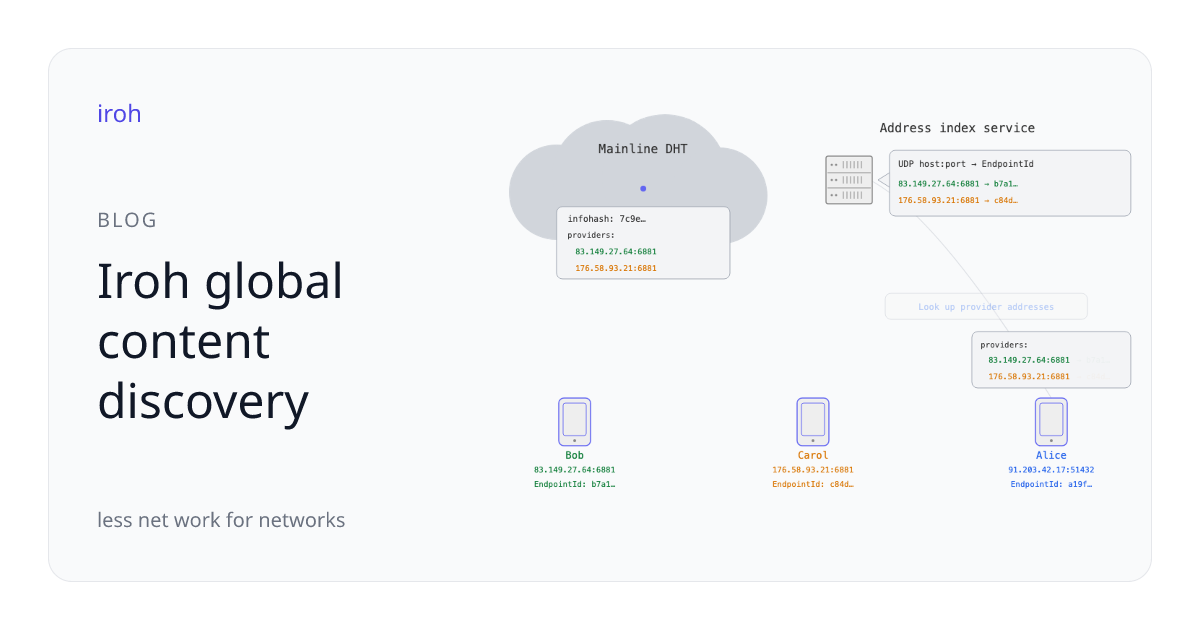
The new iroh-blobs design restores the initial “one unique identifier for each file” ethos of IPFS (abandonned by IPFS), to reduce swarm fragmentation. It takes the standard Blake3 hashing algorithm to generate file CIDs (equivalent to Bittorrent magnet infohash).
The protocol uses the Mainline Bittorrent DHT (not a custom DHT). There is no notion of block CIDs (no potential deduplication, but also less scalability issues for announcing each block CID on the DHT).
So that’s a lot of design simplifications that will improve implementation time.
If you are interested, have a try at Iroh-share, a CLI and TUI Rust implementation.
You must log in or # to comment.
I can’t help but think about this while reading this post. However, this is probably indicative of my lack of understanding of computer networks, despite dealing with it from time to time.
Sorry for that! Basic is: it’s fully decentralized, and when anyone starts sharing a file, it joins a unique swarm of seeders. Whereas on Bittorrent, there is one swarm for each torrent, each private tracker for the same file, and also for folders (TV episode; TV season; TV series); this is called “swarm fragmentation” and leads to low speed and dead torrents.
Nothing for you to apologise! Also, thank you so much for explaining it. :-)
What is your view on veilid as compared to this?
First time I hear of it. They say this is for private networking only. Also it’s only a network stack for now (the “BlockStore” storage component is not yet defined). So apparently it’s not for public filesharing. They compare it to Tor but it looks more like an overlay mesh network at first sight.
I really like two of their points:
- anonymous by design
- distributed as a library
I really hate because such projects as IPFS required me to install some extention and a niche component that is hard to understand. While it is easy for me to do it I have abandoned all hope that project like this would gain some broader popularity.
For example qbittorrent is already hard to use for most people and it does not require to install extention and background service. You just install an app.
FWIW, you can access IPFS content with an in-browser IPFS gateway now, so no need to install anything: https://inbrowser.link/
You’ll still need to install something if you want to add/pin content, etc., but the in-browser gateway is convenient for sharing links to IPFS stuff with someone who doesn’t know what IPFS is.
For Iroh-blobs, Dropwire would be the easy-to use all-in-one app (not appropriate for mass sharing just yet). Then there is the iroh-http library, allowing to use Iroh-blobs on a web browser (without installing anything; a website similar to instant.io / webtorrent.io).
Also note that most of the big Bittorrent peers have a pretty sophisticated setup anyway (allways-on machine with raid array; bittorrent daemons; remote client; VPN; download automation indexers; media library etc).Awesome. Thank you :)
Any mutability or just immutable?
I noticed the example they provide contain a list of file (CID points to a folder): https://y7rmokt6h5mryuauw83em4u1br6tqrukaw3ngtde7zp8p3bg6hto.blake3.net/ or https://5ti57aszf7kaicsncb4wgigkf9bju39kofiz8dthwdujkmz85u8y.pkarr.net/; the latter identifies the same content by a public key. I guess the public key identifier allows mutable linking.